
Honeywell Dryer Vent Cleaning in Chicago: What to Know First
We provide independent Honeywell dryer vent cleaning throughout Chicago, typically completing the job in a single visit with upfront pricing disclosed before we touch a tool. Most Honeywell systems we see are in homes built between 1985 and 2010, and the venting issues they develop are specific enough that a generic clean often misses the root cause. If you own a Honeywell dryer or vent booster and you’re noticing longer dry times, a hot laundry room, or that burnt-lint smell near the back of the machine, the vent path is almost certainly compromised. Call us at (877) 502-3903 for a free estimate - we’ll give you the honest number on the phone, and that’s the number on the invoice.
How Honeywell Products Fail - and How We Fix Them
- Honeywell TrueDRY DR90/DR120 vent boosters seize from Chicago’s freeze-thaw grit. These whole-home dehumidifier boosters sit in attics and crawl spaces where our winter temperature swings coat the impeller blades with fine road salt dust that gets pulled through soffit vents. The motor labors, overheats, and eventually stalls. We pull the booster, clean the blade assembly with a solvent that won’t degrade the OEM bushings, and test static pressure before we button it up. If the motor’s cooked, we source the exact Honeywell replacement rather than forcing a universal fit that voids whatever warranty period remains.
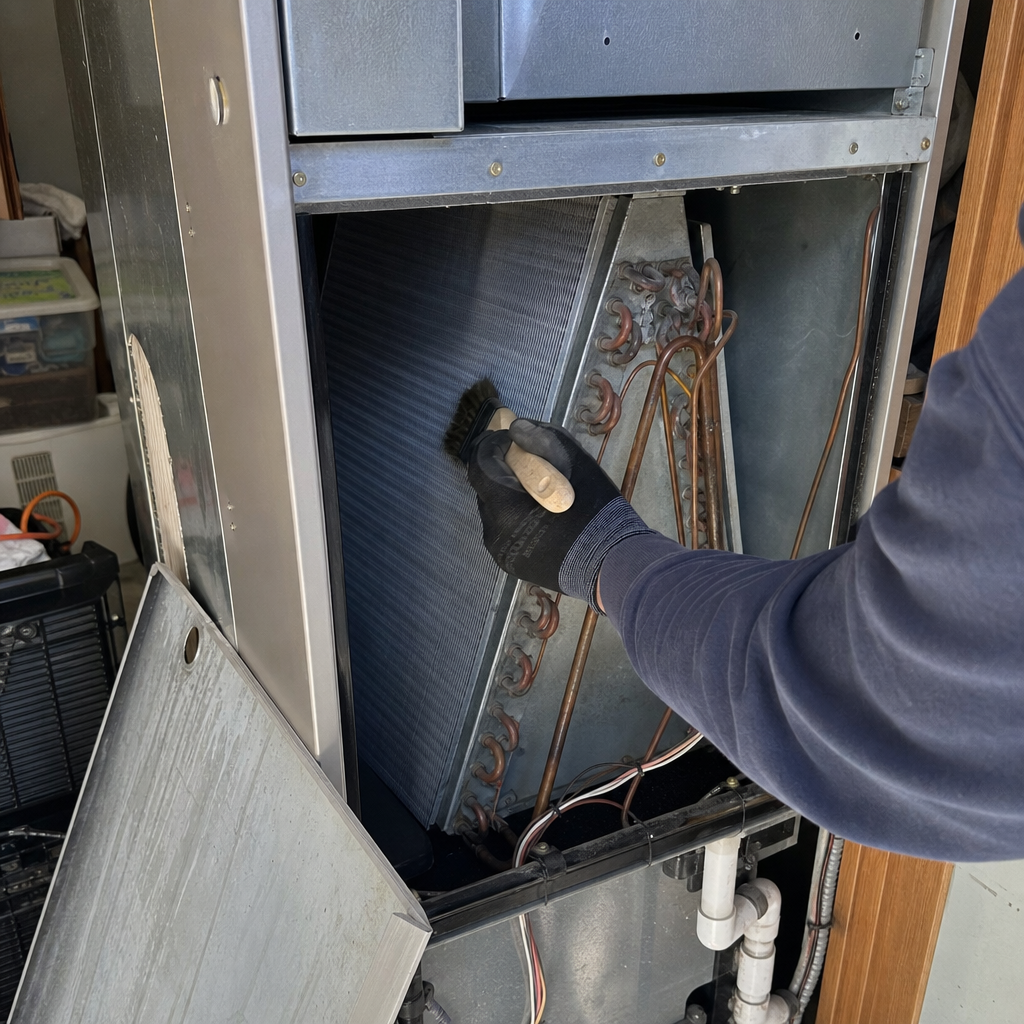
- Honeywell HVR series heat-recovery ventilators clog at the condensate drain tee. In Chicago’s lake-effect humidity, the HVR-150 and HVR-200 models we see in Lincoln Park and Rogers Park brownstones develop a sludge plug where the dryer exhaust crosses the fresh-air intake. The backpressure forces lint into the heat exchanger core, which is aluminum and not forgiving of aggressive brushing. We use a HEPA vacuum with a soft-bristle Rotobrush attachment at reduced RPM, then camera-verify the core channels are clear. We’ve had to replace three cores this past year because prior cleaners went at them with a standard duct whip.
- Honeywell UV100A UV-C lamp housings crack from vibration in stacked washer-dryer closets. The lamp itself isn’t the vent, but the housing mounts to the duct wall in tight Chicago condo mechanical closets where the dryer drum’s vibration transmits directly. A cracked housing leaks UV light and lets lint bypass the filter zone. We check these on every Honeywell job in high-rise buildings along Lake Shore Drive and the South Loop - the cracked ones we flag, and if the lamp’s within 18 months of replacement anyway, we bundle the housing swap into the cleaning price rather than charging a second trip.
- Honeywell W8150 fresh-air intakes pull dryer lint during negative-pressure events. This is the one that surprises homeowners. The W8150 is designed to bring in outside air for combustion makeup, but when it’s installed on a wall shared with the dryer vent termination, the dryer’s exhaust pulse can suck lint backward through the intake screen. We see this in bungalows on the Northwest Side where the utility room backs to an alley. Our fix is a relocated intake termination or a backdraft damper with a tighter seal than the builder-grade flap - never just a screen cleaning, because it’ll happen again next month.
- Honeywell HZ432 zone panels misreport “vent OK” because the pressure switch samples the wrong duct. The HZ432 is a zone control panel, not a vent product, but it’s what the homeowner sees flashing green when the dryer vent is actually blocked. The pressure port tees into the main return, so a partial dryer vent blockage doesn’t trip the switch until it’s nearly a fire hazard. On every Honeywell zone system we clean, we pull the pressure tube and test it independently with a manometer. The panel might say everything’s fine. The manometer never lies.
Our Honeywell Dryer Vent Cleaning Process
- 1
Call and scope. You describe the Honeywell model if you know it, the symptoms, and the house layout. We quote upfront - no “starting at” language, no range that triples at the door.
- 2
Camera inspection before we touch anything. Our tech runs a borescope from the dryer connection through to the exterior cap. You see what we see on the tablet. In Chicago’s older frame houses, we often find collapsed flexible duct behind finished basement ceilings that the homeowner didn’t know was there.
- 3
Parts decision with you, not for you. If we hit a Honeywell-specific component that needs replacement - a DR90 booster motor, an HVR core, a UV housing - we show you the OEM option and the quality aftermarket equivalent. We explain the warranty implications of each. You choose. We don’t source from auction sites or “compatible” bins.
- 4
The clean itself. Rotobrush agitation for rigid metal duct, Nikro HEPA vacuum extraction, Abatement Technologies negative air if the lint load is heavy. For Honeywell HVR cores, we drop to hand tools. No shortcuts.
- 5
Post-clean camera verification and static pressure test. The after video goes on the tablet next to the before. We measure static pressure at the dryer connection - it should read under 0.75 inches water column for a standard 25-foot run. If it doesn’t, we find out why before we leave.
- 6
Written 90-Day Done Right Promise. If anything we touched isn’t right, we come back. No paperwork to file, no argument about whose fault it was. We have been doing this long enough to know what clean looks like - and we do not leave until it gets there.
What Honeywell Dryer Vent Cleaning Costs in Chicago
| Service | Typical Range |
|---|---|
| Standard Honeywell dryer vent cleaning (single-story, accessible duct) | $189 - $279 |
| Honeywell DR90/DR120 booster removal and deep clean | $340 - $495 |
| HVR-150/200 heat exchanger core cleaning (no replacement) | $265 - $385 |
| UV100A housing replacement with lamp swap | $225 - $340 |
| W8150 intake relocation or backdraft damper install | $295 - $450 |
| HZ432 zone panel pressure verification (add-on) | $85 - $125 |
What moves the price: duct length and material (flexible costs more because we replace it), access difficulty (finished ceilings, tight crawl spaces), and whether we’re cleaning or replacing a Honeywell component. We also honor our permanent 5% Senior and Veteran discount, and our $89 Seasonal Tune-Up applies if we’re already on site for another service. Call (877) 502-3903 - the estimate is free, and the number we give you is the number you’ll pay.
Why Chicago Homeowners Call Bellows Air Duct & Vent Co. of Chicago for Honeywell Work
Ray Dempsey started this company in 1984, and we’ve been cleaning ductwork in Chicago long enough to know which builders spec’d Honeywell in which neighborhoods. We also service Lennox, Trane, and Carrier systems, so when your vent issue turns out to be cross-brand - a Carrier furnace sharing a chase with a Honeywell HVR - our techs don’t blink.
Our 90-Day Done Right Promise is stamped on every job. Our background-checked, uniformed technicians arrive when we say they will. A live person answers our phone at 2 PM or 2 AM - not a voicemail tree, not an app that routes you to a call center in another state. And we show you camera proof before and after, because a clean vent is something you should see, not just be told about.
We’re the square-deal alternative to the coupon bait-and-switch operators. One honest price, shown before we start. No surprises on the bill.
FAQs
No - independent dryer vent cleaning does not void your Honeywell appliance warranty, provided the work is performed by a qualified technician and no OEM components are altered with incompatible parts. We document our process with before-and-after camera footage specifically to protect your warranty position. If you have concerns about a specific Honeywell model, call us at (877) 502-3903 and we’ll verify the warranty terms with you before we schedule.
Most standard cleans take 90 minutes to two hours from truck arrival to final static pressure test. Honeywell systems with integrated boosters or HVR cross-connections add 30 to 45 minutes for proper disassembly and reassembly. We book morning and afternoon windows in Chicago and the near suburbs, and we’ll be there when we say. Call (877) 502-3903 to check today’s availability.
Repair makes sense if the DR90 or DR120 motor is under eight years old and the housing isn’t cracked from freeze damage. Replacement is the better call when the unit has already been repaired once, or when the impeller is scored from running unbalanced. We’ll show you the motor amp draw and the housing condition on camera, then quote both options upfront. Our $50 Off Any Repair Over $250 applies to booster work if that’s the route you choose.
We carry common Honeywell vent components - DR90/DR120 motors, UV100A housings, standard backdraft dampers - on our Chicago service trucks. HVR heat exchanger cores and specialized zone panel sensors we source from our distributor in Melrose Park, typically next-day. If your job requires a part we don’t have, we’ll tell you before we start, not after we’ve got your ductwork apart. Call (877) 502-3903 and we’ll confirm parts availability for your specific model.
A blocked vent shows these signs: clothes take two or more cycles to dry, the dryer exterior is hot to the touch, and there’s lint accumulation behind the machine or at the exterior cap. A failing dryer heating element or thermostat won’t produce those specific symptoms. Our camera inspection settles the question in five minutes - we’ll look at the vent path with you on the tablet and tell you what we find. Free estimates, no obligation. Call (877) 502-3903.
Written by Ray Dempsey, Owner, Bellows Air Duct & Vent Co. of Chicago at Bellows Air Duct & Vent Co. of Chicago, serving Chicago and nearby areas.